The internet never sleeps. Every second, thousands of automated programs—commonly called “bots” or robots—silently crawl the web, analyzing, indexing, and scraping. They go by names like Googlebot, Bingbot, GPTBot, and SemrushBot. They work for search engines, artificial intelligence, and SEO analysis tools. Their activity is invisible, underground, and yet omnipresent.
It was from this observation that Krafsht, in collaboration with RTMKR, conceived bots.krafsht.com: a unique, minimalist, and aesthetically radical page that makes the invisible visible. A real-time visualization tool for bot traffic on their own web projects—designed not as a cold dashboard, but as a visual work in its own right, directly inspired by the aesthetics of the film The Matrix.
Context: the explosion of bot traffic
912
The rise of generative artificial intelligence—ChatGPT, Claude, Mistral, Gemini—has radically changed the nature of web traffic. While search engine bots have existed since the early days of the web to build indexes, a new wave of crawlers has emerged, driven by Large Language Models (LLMs) hungry for training and update data.
OpenAI uses GPTBot to scrape. Mistral sends out its own agents. Anthropic crawls with ClaudeBot. According to some estimates, automated traffic now represents more than half of all internet traffic.
For webmasters and digital agencies like Krafsht, understanding who visits their sites—and especially distinguishing humans from machines—has become a major challenge, impacting performance, security, and editorial strategy. This project is situated within this context.
When robots invade the screen
bots.krafsht.com is a one-page web page built with PHP, JavaScript, and jQuery, hosted on a standard server. Its operation relies on a two-step mechanism, elegant in its simplicity:
- Upstream, a PHP script (gobots.php) discreetly analyzes the User-Agent of each visitor arriving on the monitored projects. When it detects a known bot signature—Googlebot, Bingbot, Yahoo Slurp, DuckDuckBot, Baiduspider, YandexBot, SemrushBot, AhrefsBot, or even generic scripts like curl or wget—it records the event in a daily log file. Each entry records four pieces of information: the date and time of the visit, the URL visited, the bot’s raw User-Agent, and its identified name. Everything is stored in simple text files, without a database or unnecessary complexity.
- Downstream, the main page (index.php) retrieves the last five days of logs, parses them, and injects all the entries as a JSON array directly into the JavaScript. This is where the magic happens: a fully custom canvas animation engine takes over.
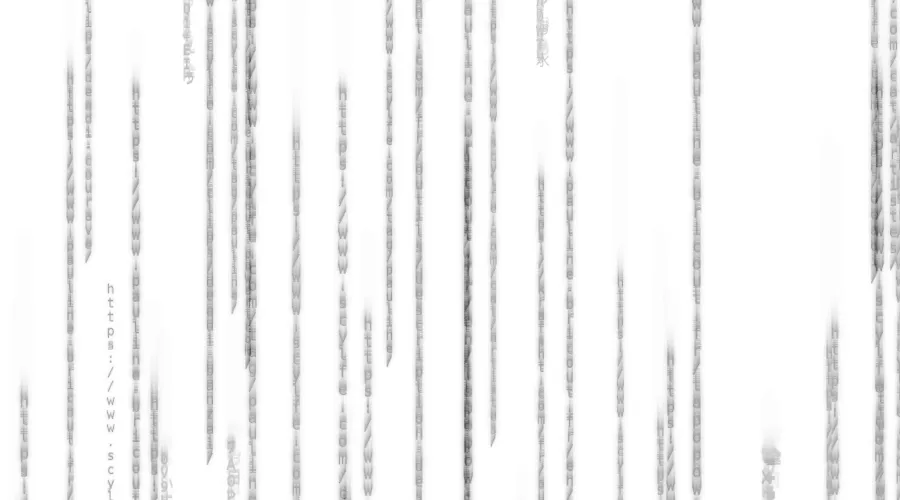
Inspired by the famous “code rain” from the film The Matrix, the graphics engine animates columns of text that fall vertically across a full-screen canvas. But unlike the film’s rain of Japanese characters, each column here doesn’t represent a random glyph—it represents a real URL, visited by a real bot, on a real date.
The sentences fall at varying speeds, in random font sizes within a defined range, and pass through a central “reveal” zone where the scrambled characters reveal the readable text—allowing the human eye to quickly grasp a URL, a User-Agent, or a bot name. A DOM layer superimposed on the canvas even makes these URLs clickable, transforming the visualization into a navigation tool.
The chosen aesthetic is deliberately inverted compared to the film: white background, dark text. This approach enhances readability while moving away from the dark-green cliché, and aligns with Kraftsht’s understated visual identity. The animation settings are very precise: appearance density, minimum/maximum speed, font size, reveal persistence, trail effect—everything is configurable and documented in comments within the source code. The page automatically reloads every 12 minutes to display the most recent logs without any user intervention. Compatibility with prefers-reduced-motion is maintained for users sensitive to animations.
At the intersection of art and monitoring
bots.krafsht.com is what you might call functional “data art”: it has a real purpose—understanding bot activity on your own projects—but it wraps it in a powerful visual and sensory experience. There are no charts, no graphs, no cold numbers. Just a cascade of raw data that falls, blurs, reveals itself, and disappears.
It’s also a technically humble project in the best sense of the word: no heavy frameworks, no databases, no superfluous external dependencies. Proof that visual innovation doesn’t need architectural complexity to exist.
Created by Krafsht in collaboration with RTMKR, this project perfectly illustrates the agency’s philosophy: giving meaning and form to raw data, transforming technical infrastructure into a human experience, and reminding us—with a touch of cinematic humor—that behind every website, the silent war of bots rages on, 24/7.